
%20compressed.jpg)
How to communicate to be understood?
Great leaders do not seek out the perfect communication style because there isn't one. Rather, they learn how to modify and translate their message to suit various personalities. But how to do it?
After more than twenty years of leading manufacturing companies in Europe and India, one thing has become abundantly clear to me: many quality issues that you would expect to begin on the production line actually begin much earlier, during conversations.
Not out of people’s carelessness or lack of knowledge. Usually, the problem is far simpler. Two people get the same message but interpret it differently. When I realized that, it changed the way I lead and communicate with my teams.
Clear speaking does not always mean clear communication
One of the most common mistakes in leadership is assuming that if we explain something clearly, the other person will automatically understand it in the same way. That is rarely true.
The same message can be given to four employees and create four completely different reactions. One person feels motivated. Another feels controlled. Someone else becomes confused. Another quietly disconnects from the topic.
That’s because there is no such thing as universal communication and a leader should know that. The art is to communicate appropriately to the situation and the person you are speaking with, so that the other they can understand.
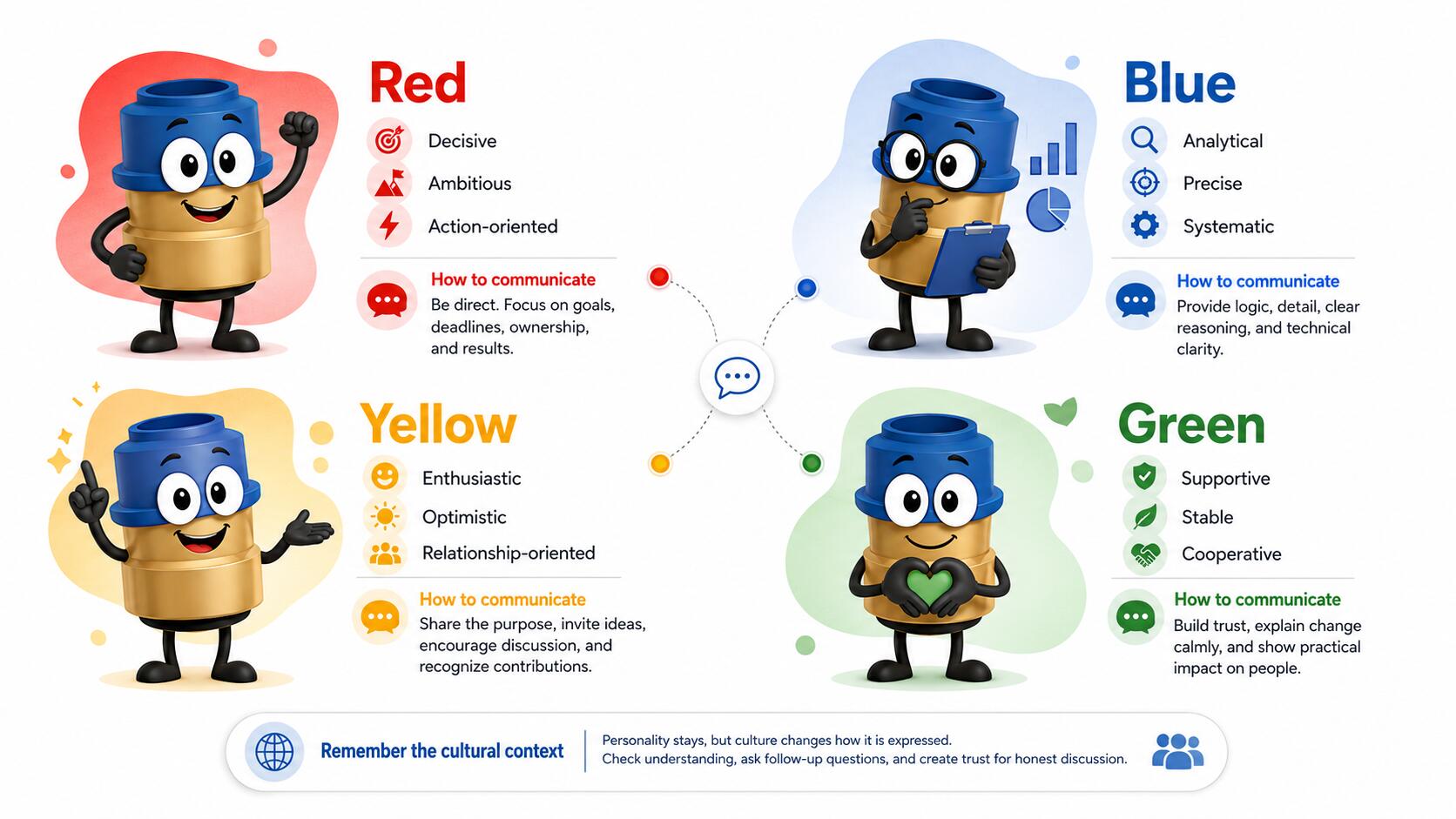
Over the years, I have found the four-colour personality framework helpful in this area. Of course, no model can describe a person completely. People are more complex than any colour, category or diagram. But the framework gives leaders a practical starting point. It helps explain why people react differently to the same information and how we can adapt our message so that communication leads to action, not confusion. (More about this framework later.)
Culture changes the meaning of communication
The other side of this picture is culture.
Working in India taught me that not every leadership habbit can simply be copied from Europe and expected to work in exactly the same way.
Indian business culture is strongly based on relationships, respect and trust built over time. Communication is often more indirect than in many Western countries. Maintaining harmony and protecting the relationship can be more important than saying disagreement openly and immediately.
For a European manager, this can be difficult to read at first. A simple “Yes” does not always mean “I agree.” Very often it means “I understand what you are saying.”
That difference matters. If a manager assumes that “yes” means full commitment, misunderstandings can appear very quickly. Instead of assuming agreement, leaders need to ask follow-up questions, invite discussion and create enough trust for people to share concerns early.
Personality isn't changed or replaced by culture, but it changes how it is expressed.
A Red personality in India may still want fast decisions and ambitious goals, but may express disagreement more diplomatically than a Red manager in Germany.
A Blue personality may notice a technical risk immediately, but may hesitate to challenge a senior manager unless invited to speak openly.
Yellow personalities often do well in India’s relationship-based environment because building connections comes naturally to them.
Green personalities usually appreciate a culture built on cooperation and stability, although they may need encouragement to speak up when something worries them.
Good leaders adapt their communication on both levels: to the person in front of them and to the culture in which that person works.
Red: focus on results
Let's talk a little more about every personality.
Red personalities are decisive, ambitious and action oriented. They value speed, clear goals and measurable results. They usually do not need long explanations. They want to know what needs to be done, when it needs to happen and who is responsible.
With Red personalities, communication works best when it is short, direct and focused on outcomes. Give them ownership, be clear about the target and avoid unnecessary control. When they understand the goal and have space to act, they often move very quickly.
Blue: precision creates quality
Blue personalities are analytical, systematic and focused on details. Some managers see them as too cautious and slow. I see them differently. Very often, these are the people who prevent expensive mistakes before they reach the customer.
They check specifications, ask difficult questions and notice risks that other people miss.
To communicate well with Blue personalities, leaders need to provide complete information, clear logic and enough detail. They need to understand not only what decision has been made, but also why it has been made.
In manufacturing, this has a direct effect on customer satisfaction. Products unfortunately are not judged by good intentions, but precision, compliance and reliability.
When engineers, quality specialists and production teams understand technical requirements clearly, they are more likely to deliver components correctly from the first production run.
For customers, this means:
deliveries with fewer defects
better compliance with technical specifications
fewer interruptions in production
lower warranty costs
more confidence in every shipment
In this sense, good communication with analytical employees becomes part of the quality system, even if it is not written as a procedure.
Yellow: purpose inspires creativity
Yellow personalities are enthusiastic, optimistic and strongly relationship oriented. Facts alone rarely move them, but if they have a purpose, that's a different story. They become more engaged when they understand why a project matters, who it helps and how their contribution fits into the bigger picture.
Leaders who encourage discussion, listen to ideas and recognize achievements can often unlock a lot of energy from Yellow personalities. They bring creativity, optimism and momentum, especially when the team needs fresh thinking.
Green: trust builds commitment
Green personalities value stability, cooperation and consistency. They are often the people who quietly hold organizations together. They build trust, support others and create continuity inside teams.
They respond well to leaders who listen carefully, explain the reason behind change and show how decisions will affect people in practice. Green personalities usually do not like unnecessary pressure or sudden changes without context. But once they are committed, they can become some of the most loyal and dependable people in the organization.
Customers feel the quality of our internal conversations
Consumers neither show up for our production meetings nor listen in between engineers, planners, quality teams, and manufacturing workers. Every day, in every dimension, inspection report, delivery date, and quality issue resolved or not, what they experience is the outcome of those dialogues.
For this reason, communication is far more than just a leadership tool. We can say that it's a quality tool. It's reducing errors, speeding up problem-solving and helping teams cooperate before small issues become expensive problems. As a result, over time, it also helps build customer confidence.
The quality a customer receives begins before the first machine starts working. It begins with people understanding one another.
The best leaders learn to translate
Great leaders do not seek out the perfect communication style because there isn't one. Rather, they learn how to modify and translate their message to suit various personalities. At the same time, they remember to respect cultural differences, and at the end, they check whether the message was understood.
When people understand each other better, they cooperate better. When they cooperate better, quality improves. And when quality improves, customers trust the company more. In B2B and also B2C relations, that trust is difficult to win and easy to lose. For me, it remains one of the strongest advantages a company can build.
About the communication framework
The four-colour communication framework in this article is inspired by the Insights Discovery methodology, which draws on the psychological type theory of Carl Gustav Jung. Similar behavioural concepts can also be found in the DISC model, based on the work of psychologist William Moulton Marston.
These models simplify human behaviour, so they should not be treated as complete descriptions of people. Used carefully, however, they can help leaders understand communication differences and work better with their teams.
%20compressed.jpg)