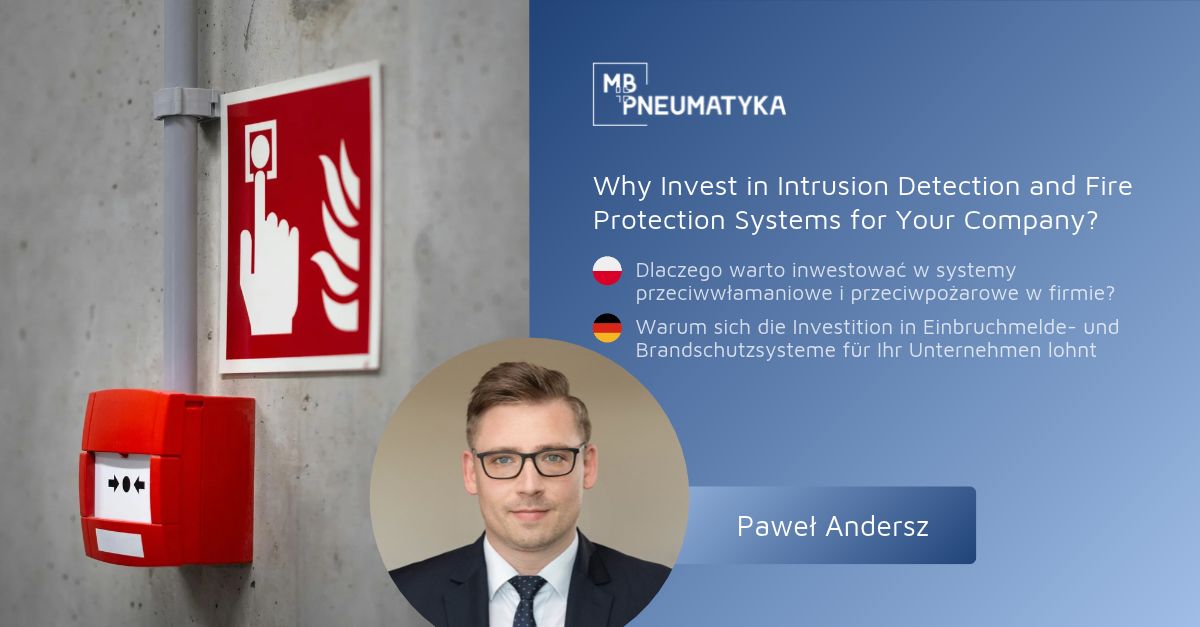
Why Invest in Intrusion Detection and Fire Protection Systems for Your Company?
A few years ago, our company narrowly avoided a fire. A burningbin right next to the production hall nearly caused the flames to spread to the entire building. Thanks to the quick response of our Area Manager, Łukasz Karpiej, the fire was extinguished and we avoided serious losses.
This incident made us realize just how crucial prevention is. That is why, during modernisation work on our new building, we also made sure to install a fire detection system in the older part of the facility.
Modern businesses face numerous threats—ranging from break-ins and fires to cyberattacks. Proper physical security is not just a matter of safety, but also a key element of business strategy. Increasingly, implementing intrusion detection and fire protection systems is no longer merely best practice, but an absolute necessity—including from an insurer's perspective and for compliance with standards such as TISAX, which is required by many clients, particularly in the automotive industry.
Below, we explain why investing in these systems is worthwhile and what tangible benefits they bring to businesses.
Protecting People, Property, and Business Continuity
Alarm and fire protection systems form the foundation of safety in every company. Their role is not only to deter potential intruders or detect a fire at an early stage, but also to protect the lives and health of employees, as well as safeguard infrastructure, machinery, and documentation.
Equipment failure or loss (e.g., due to a break-in or fire) can result in production downtime, data loss, or the loss of clients. In the worst-case scenario, it can threaten the company's continued operation. Implementing effective security measures minimizes the risk of such scenarios.
Meeting Audit and Certification Requirements – Such as TISAX
Companies cooperating with the automotive industry (e.g., as OEM suppliers) are frequently required to comply with the TISAX (Trusted Information Security Assessment Exchange) standard, which governs information security—both digital and physical.
TISAX does not focus solely on IT; it also covers building security, access control, video surveillance, and fire protection systems. Lacking these measures can result in failing an audit and losing a client contract.
Implementing such systems is therefore not only a matter of safety, but also of competitiveness and trust in B2B relationships.
At MBP, we plan to complete TISAX certification in 2027, though we already see full alignment with its requirements. Thanks to our investments, clients can rest assured that their entrusted assets—such as documentation—are safe.
Protecting Data and Intellectual Property
In the era of digitalization and remote work, physically securing office spaces, server rooms, warehouses, and production halls is of paramount importance. The theft of a laptop, documentation, or even data storage media can expose a company to personal data breaches, the disclosure of trade secrets, and the loss of competitive advantage. Implementing security systems is a vital component of personal data protection policy (GDPR) and risk management.
Building the Image of a Responsible and Trustworthy Company
Investing in security also sends a clear signal to clients, partners, and employees that the company takes its responsibilities seriously. This translates into greater trust from business partners, a stronger market reputation, and higher engagement among employees who feel safe at work.
To an insurer, every company represents a potential risk. The lower that risk, the more favorable the policy terms can be. In practice, implementing effective security measures can directly translate into lower insurance costs as well as broader coverage.
Insurers calculate premiums based on risk assessments. When a company has certified alarm systems, video surveillance, access control, or smoke detectors in place, the risk of fire or burglary drops significantly. The result? An insurer may reduce the premium by a dozen or even several dozen percent. In many cases, an insurer will refuse to cover property altogether if basic safeguards are missing. This may apply to, among others: server rooms and data, high-value production machinery, warehouses storing goods, and confidential documents. A lack of alarm or fire suppression systems can mean denial of coverage or a significant limitation in policy scope.
Companies equipped with appropriate security measures can count on: higher liability limits, fewer coverage exclusions (e.g., avoiding claims of gross negligence), and a streamlined claims settlement process (e.g., supported by surveillance footage or sensor logs). This means faster and fuller compensation payouts in the event of an unforeseen incident.
Some insurance companies offer special discounts for businesses that meet specific property protection standards. These are often detailed in the General Terms and Conditions of Insurance (GTC) and may include: Grade 3 (SA3-class) or higher alarm systems, flood, carbon monoxide, and smoke detectors, smoke extraction systems, 24/7 monitoring, or cooperation with a security agency.
For large policies covering manufacturing, logistics, or automotive companies, the insurer often conducts a risk audit. An expert evaluates not only the technical condition of the machinery, but also: fire protection measures (detectors, hydrants, fire zones), access control to sensitive areas, evacuation plans, and incident response procedures.
We have already successfully implemented all of these measures at MB Pneumatyka—across both of our locations.
Misfortunes Never Come Singly
Implementing intrusion detection and fire protection systems is an investment that truly pays off—both financially and in terms of corporate image. Thanks to them, a company protects its people and assets, avoids downtime and losses, secures better insurance terms, meets standards such as TISAX, and boosts its credibility and competitiveness.
If your company has not yet put proper security measures in place, now is the best time to change that. Later, at the least expected moment, you will thank yourself for not cutting corners on safety.