
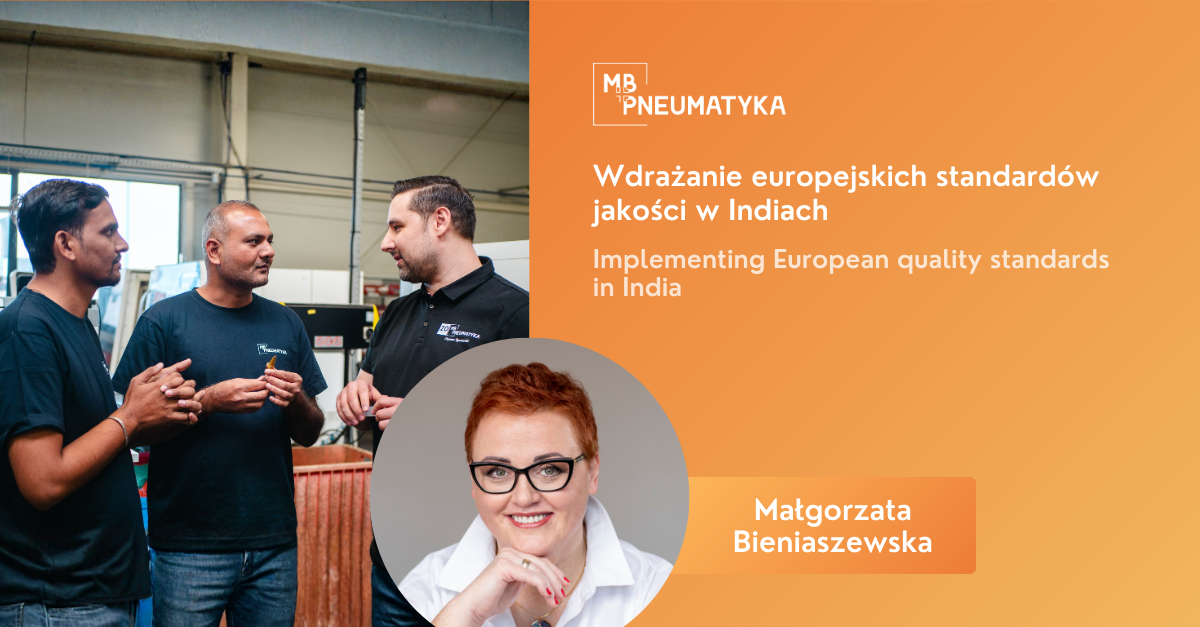
Implementing European quality standards in India
Four years ago, we started in India practically from scratch. We had experience in Europe, functioning processes, and quality embedded in standards. But it very quickly turned out that entering the Indian market is not a simple export of solutions. It is a test of whether quality – understood as a way of operating – really works outside its own context.
Because India is not just a different market. It is a different approach to decisions, risk, and business relationships.
Quality management in Poland – system, standards, and execution
In Poland – especially in the automotive industry – quality is systemic. It is based on standards such as IATF 16949, which were created to ensure process consistency, error reduction, and continuous improvement in the global supply chain.
In practice, this means that:
· quality is "built-in" to processes,
· audits perform a control function,
· organizations operate at a high level of repeatability.
This is an environment where quality is enforced – through structure, system, and responsibility.
Implementing quality in India - why the same model doesn't work
In India, the same set of tools is not enough.
Not because standards are less important. On the contrary – the development of the automotive sector in India has been strongly linked to the implementation of global quality systems and the growing requirements of OEMs.
The problem lies elsewhere.
Quality there is not something that can be implemented through documentation. It must be developed in practice – in relation with the client, the team, and the operational context.
Quality management research shows that the effectiveness of quality practices is highly dependent on the cultural context - including management style, approach to hierarchy, and decision-making methods.
This means one thing: quality management in different cultures requires different approaches.
Why entering the Indian market is a "long game"?
One of the biggest surprises is the pace of decisions.
In Europe, simple logic often applies:
better product → faster decision → implementation.
In India, the process looks different:
the client wants to see the solution,
then test it,
then convince the organization,
only at the end is a decision made.
This process cannot be accelerated.
It’s not a matter of poorly executed sales. In India, you have to build trust and prove your quality for a long time.
It is no coincidence that analyses of global operating models show that the effectiveness of implementing manufacturing methods (e.g., lean or agile manufacturing) significantly differs between countries and depends on organizational maturity and the local context.
IATF in India – the standard as an educational tool, not just a system
In Europe, IATF acts as a management system.
In India, it very often plays an additional role – that of an educational tool.
This means that:
· the standard must be translated into daily activities,
· processes must be "translated" into real decisions,
· leaders must actively build an understanding of quality.
The standard itself is not enough.
This is consistent with the approach presented in McKinsey operational analyses, which emphasize that manufacturing advantage does not come from implementing tools, but from their appropriate adaptation to the organizational and cultural context.
Manufacturing Leadership: Poland vs. India
The biggest difference, however, reveals itself at the leadership level.
In Poland, a production leader:
· enforces standards,
· optimizes processes,
· reacts to non-conformities.
In India, a leader must:
· build trust,
· explain the "why",
· act patiently and consistently,
· support change instead of forcing it.
This shifts the weight from process management to context management.
And this is precisely where quality stops being a technical topic and becomes a leadership topic.
Implementing European quality standards in India – the most important lesson
After four years, we are seeing the results:
· year-on-year growth,
· new projects,
· partnerships with OEMs.
However, we reached this not through a quick "process implementation". We had to strive for it through:
· presence,
· patience,
· consistency in showing value
· building quality in practice.
India teaches one thing very clearly: this is a long-term game.
What quality really is in a global organization
This experience has greatly changed our approach to quality. It is no longer just a certificate, procedure, and documentation. It has become daily decisions and a way of reacting to problems and, above all, the consistency of action – regardless of the country.
If these decisions remain consistent in Poland and India, across different teams and cultures – then you can talk about real quality.
And perhaps this is the most important test for any organization thinking about global growth.
%20compressed.jpg)