
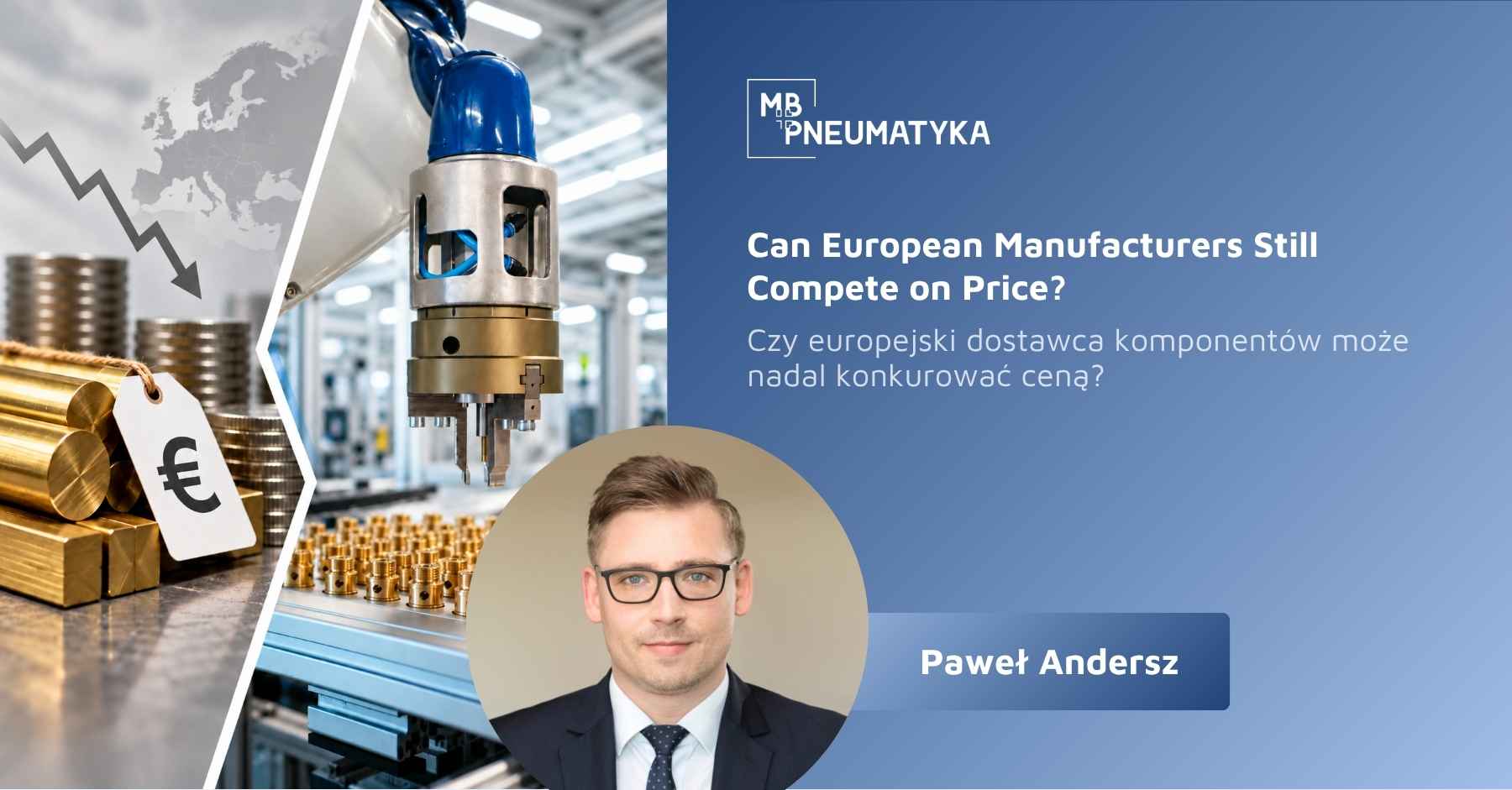
Can European Manufacturers Still Compete on Price?
Can a European component supplier still compete on price with manufacturers from Asia? Why are productivity, process stability and flow increasingly determining the real cost of production, rather than the price of a labour hour alone?
For years, industrial sourcing followed a simple assumption: Europe meant quality, while Asia meant lower prices. That distinction is becoming less useful. European manufacturers will rarely win by offering the lowest labour cost per hour, but labour cost is only one part of the price of a component. What matters much more is what happens during that hour: how many good parts the factory produces, how much time it loses to changeovers, downtime and quality problems, how much material remains between operations, how predictable the process is and how quickly the company can react when demand changes.
These questions lead to a different view of manufacturing competitiveness. A European factory does not have to offer the cheapest hour. It has to make better use of every hour it pays for.
The material advantage is smaller than it may seem
Manufacturers in different parts of the world do not operate in completely separate commodity markets. Metals such as copper and aluminium have international reference prices, including quotations from the London Metal Exchange. The final purchase price still varies because of transport, energy, local premiums, exchange rates, financing and order volumes, but it is too simple to assume that a manufacturer in another region can offer a much lower price because its raw material costs a fraction of the European price.
In many cases, the larger difference appears after the material enters the factory. From that point, competitiveness depends on how efficiently the company turns raw material into a finished, compliant product. That is where manufacturing systems begin to matter.
A cheap working hour can produce an expensive component
Labour rates are easy to compare. Productivity is harder. Imagine two factories producing the same component. Factory A has a much lower hourly labour cost, but its machines stop often, changeovers take a long time, scrap is high, production planning creates queues and large amounts of work in progress remain on the shop floor. Factory B pays significantly more per hour, but its process is stable, changeovers are shorter, machines run consistently, quality problems are detected early and production flows with fewer interruptions.
Which factory has the lower production cost? The answer cannot be found by comparing hourly wages. A company does not earn money because labour is inexpensive. It earns money when it can turn material into products that meet customer requirements and can be shipped and sold. This is why productivity matters more than the labour rate alone. The useful question is: How much value can the factory create with the resources and time available?
The purchase price is not the full cost
This matters even more in automotive manufacturing. A component can look attractive on a quotation and become expensive later. Poor quality creates sorting, complaints and additional inspections. Delayed deliveries require emergency transport or larger safety stocks. Unstable production creates more planning work, while a serious defect can stop a customer's production line. The cost of these problems can quickly exceed a small saving in the original purchase price.
Reliable manufacturing requires investment in capable machines, tooling, measurement systems, preventive controls, traceability and trained employees. It also requires engineers who understand the process and can react before a problem reaches the customer. All of this has a cost, but an unstable process has a cost too.
That is why sourcing decisions should go beyond the question, “What is the price per piece?” Another question is often more important: “What will this component actually cost us once quality, logistics, inventory, risk and engineering time are included?” The lowest quotation and the lowest total cost are not always the same thing.
Why we look at throughput instead of isolated costs
At MB Pneumatyka, this way of thinking is closely connected with the Theory of Constraints developed by Eliyahu Goldratt. One of its most useful ideas is simple: improving every individual operation does not automatically improve the performance of the whole factory.
Every production system has a constraint. It may be one machine, one process, one measurement operation or one organisational decision that limits how much the system can produce. If the constraint can produce 1,000 parts per day, making another machine capable of producing 5,000 instead of 4,000 parts does little if those additional parts simply wait in front of the bottleneck. The local efficiency number improves, but the factory does not necessarily make more money.
The Theory of Constraints focuses attention on three measures: Throughput, Inventory and Operating Expense. This changes the questions management asks. Instead of asking, “How can we reduce the cost of this operation?”, we can ask, “What is limiting the output of the whole system?” Then we can work on that limit.
The answer may be a shorter machine cycle, a faster changeover, higher machine availability, different batch sizes, automation or moving work away from the constraint. Sometimes the right decision can even increase the cost of one operation. Traditional cost accounting may make that decision look inefficient, but if the change frees capacity at the constraint and allows the company to sell more finished products, the result for the entire business can improve. Local cost reduction and global profitability are not the same thing.
Productivity changes the labour cost equation
This is where I see a strong opportunity for European manufacturing. Europe has high labour costs, and the answer is not to pretend otherwise. The answer is to reduce the importance of labour cost in each finished component by producing more value with the same resources.
Technology and automation help, as do process knowledge, good maintenance, engineering competence, quality control and production data. But technology alone is not enough. A highly automated factory can still perform poorly if its flow is badly organised. An expensive machine can become an expensive waiting station. The real advantage comes from combining technology with a well-designed production system.
If a factory increases output without increasing resources at the same rate, the cost structure changes. The same building produces more, the same machine hours create more sellable products, the same engineering team supports a larger production volume and the same fixed costs are distributed across more output. At that point, the difference in labour rates between regions becomes less important.
Europe also has another advantage: distance
Manufacturing cost does not end at the factory gate. Supply chains have a cost too. Long transport routes require time, and long lead times often require more stock. More stock ties up cash and makes demand changes harder to manage.
When a supplier is closer to the customer, communication can also become easier. Engineering changes can be discussed faster, samples can arrive sooner and quality problems can be analysed with less delay. For many customers, these factors have measurable value.
This does not mean that local sourcing is always better. Global supply chains remain essential, and there are excellent manufacturers in every major industrial region. The point is different: a purchasing decision based only on the component price can hide costs and risks that appear elsewhere in the system. For some products, a European supplier can remain competitive even when its quotation is not the lowest number in the first column of a spreadsheet.
This is how we approach competitiveness at MB Pneumatyka
At MB Pneumatyka, we do not want to make components cheaper by lowering the standards behind them. We prefer to work on the process. We look at time lost at constraints, analyse changeovers and machine availability, study work in progress, improve process stability and look for operations that can be automated or reorganised.
Most importantly, we ask where a change will improve the performance of the whole production system. Sometimes a few minutes saved at the right machine matter more than hours saved somewhere else. Sometimes reducing work in progress creates more value than increasing the nominal speed of another operation. Sometimes better process control prevents a quality problem that would cost far more than the improvement itself. These are small decisions when viewed separately, but together they determine whether a European factory can compete.
So, can a European supplier still compete on price?
Yes, but the definition of price has to become more precise. European manufacturers are unlikely to build their future around the world's lowest labour rates. They can compete through higher productivity, stable quality, engineering competence, automation, reliable delivery and better use of their production capacity.
The goal is simple: get more good product from every machine hour, lose less time to instability, use less inventory to maintain the same service level, prevent problems before they reach the customer and increase throughput without increasing costs at the same rate.
A factory that can do these things does not need the cheapest labour hour to produce a competitive component. For me, this is one of the key questions for European industry in the coming years. The winners will not be the companies that can buy the cheapest hour of work. They will be the companies that know how to get the most value from every hour they already have.
%20compressed.jpg)