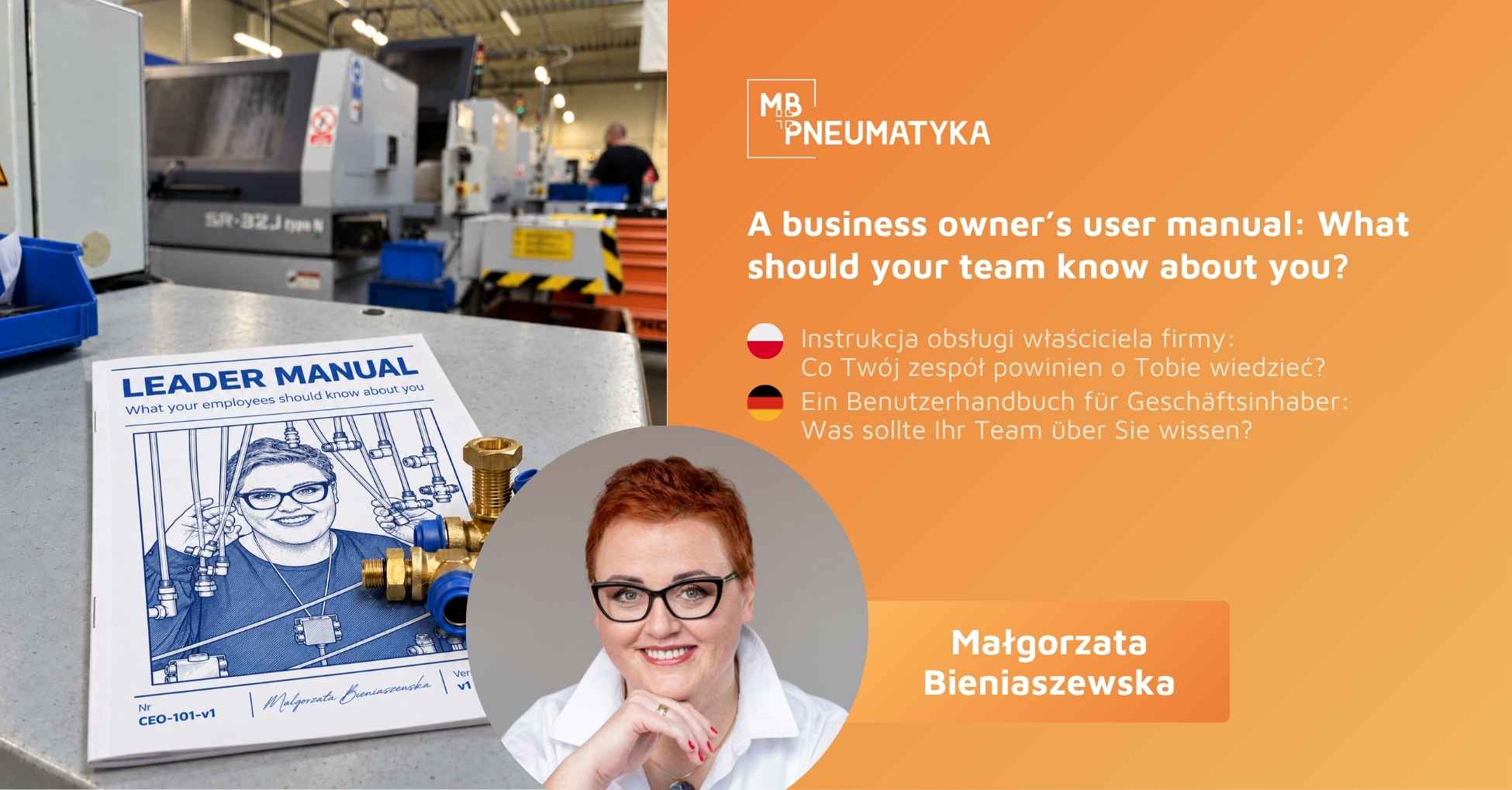
A Business Owner’s User Manual. Why Should Your Team Know How to Work With You?
Does your team know how best to work with you? Clear rules for communication, decision-making and responsibility can save a great deal of time, misunderstanding and unnecessary escalation. That is why every business owner should have their own user manual.
For many years, business taught us that a company owner should project a certain image. Professional, composed and somewhat reserved. Someone who knows more than others, has the answers and, ideally, does not show too often that they do not know something, are worried about something or are simply having a bad day.
The longer I run companies, and today I own three of them, the less I believe in this model of leadership.
It is not because professionalism has become less important. Quite the opposite. But professionalism does not mean pretending to be someone we are not.
We all have our own way of working, making decisions and communicating. We all have things we value highly and things that make cooperation much harder for us. Some people need data, while others first want to see the bigger picture. Some want to hear about a problem immediately, even if there is no solution yet. Others prefer to hear: "We have a problem. We have analysed three options, and we recommend this one."
The problem starts when the team has to guess all of this.
Instead of Guessing, Here Is My User Manual
When we buy a complex piece of equipment, we expect a manual. Yet we ask people to work with the most unpredictable element in any organisation, another human being, and assume that they will somehow figure it out.
That is why I believe every business owner should have their own informal user manual.
I share mine practically from the start of our cooperation.
When a new person joins the company, especially if they will work directly with me, I tell them clearly how to communicate with me and what they can expect from me.
First: I am a direct person.
If I do not like something, I will probably say so. If I think something can be done better, I will say that too. It does not mean I have something against the person. I talk about the issue, the problem or a specific behaviour, not about someone’s value as a person.
At the same time, I expect exactly the same in return.
If you disagree with me, tell me. If you think I am making a bad decision, give me your arguments. If you do not understand something, ask. If I have made a mistake, I want to know.
I am not interested in one-way communication just because I own the company.
What I do not like is analysing an issue endlessly, building an emotional story around a problem, taking offence or, to put it simply, creating drama. To me, a problem is something that needs to be identified, understood and solved. It is not something we should spend the next few days building tension around.
Second: when you bring me a problem, bring at least part of a solution with you.
I do not expect you to always know what to do. That would be unrealistic. Some situations are difficult or new, and sometimes no answer is obvious.
But if you come to me and say, "We have a problem," I also want to hear: "I think we can do A or B. I am not sure yet, but I have analysed it and these are the options I see."
You may be wrong. Your ideas may not work. Together, we may find a completely different solution. That is not a problem. What would be a problem for me is coming with the problem alone and expecting someone else to start thinking for you. I want to see that before you knocked on my door, you had already started thinking about it yourself.
Third: before you ask me to make a decision, think about whether it is really my decision to make.
This is one of the things I pay particular attention to.
"Małgosia, what should I do?"
My first thought is often: is this really something I should decide?
If the decision falls within your area of responsibility, I will not make it for you. I can discuss it with you. I can ask questions. I can tell you how I see it. But I do not want to take the decision away from you simply because it is easier to move it one level higher.
Because when I take away your ability to decide, I also take away something much more important: your independence and responsibility for the consequences of that decision.
A good leader is not someone who asks the owner what to do every time. A good leader analyses the situation, makes a decision and takes responsibility for it. And I want good leaders around me.
Of course, this also means something for me. If I want people to make decisions, I have to accept that not every decision will be exactly the one I would have made. I cannot say "be independent" and then punish every decision that differs from mine. Independence only works when we genuinely give people room to use it.
Fourth: I really enjoy working with people who know more than I do.
I do not need to be the smartest person at the table. Quite the opposite. If I hire an expert, I want them to know more than I do in their field. If I hire a manager, I want them to bring a perspective I do not have. I want to hear: "I disagree with you, and I will show you why."
I want to learn from you rather than simply expect you to learn from me. For me, this is one of the most important tests of a leader’s maturity. If the owner has to be the greatest expert in every area of the company, sooner or later they will become the company’s biggest limitation. I do not want to be a limitation for my companies.
I want to surround myself with people who bring knowledge, experience and perspectives that I do not have.
People Should Not Waste Energy Trying to Read the Owner
This is my user manual.
Will this way of working suit everyone? Probably not. But I would much rather say it openly at the beginning than let someone spend the next six months trying to work out "what the owner really meant."
In many organisations, a huge amount of energy does not go into the customer, the product or solving problems. It goes into interpreting the boss or the owner.
"How do you think she will react?"
"Should we tell her now or wait?"
These questions cost time. And in B2B, time very often means money, including our customer’s money.
Imagine a simple situation. A customer reports an urgent technical problem. The engineer understands the issue, the salesperson understands the customer’s expectations, and production knows what can be done. But nobody knows whether they are allowed to make the decision without the owner.
Then the internal ping-pong begins. An email. A phone call. Another confirmation. A meeting. "Let’s wait until the boss decides." Meanwhile, the customer simply waits.
And this is exactly where authentic and conscious leadership stops being a soft HR topic. It becomes a competitive advantage.
If You Know My Values, It Is Easier to Make Decisions Without Me
A good owner’s "user manual" should not focus only on personality. Its foundation should be values. Not the ones written in large letters on the reception wall, but the real ones.
If I tell my team that customer safety matters more than short-term sales, then when there are technical doubts, an employee should not wonder whether it is better to ship the product and hope for the best. They should know what decision to make.
If I say that I want to hear bad news quickly, people should not spend two days preparing a beautiful presentation before telling me that we have a problem.
If I say that I expect responsibility, I also have to give people the right to make decisions and to make reasonable mistakes.
Values only start to matter when they help people make decisions even when the owner is not in the room.
Directness Only Works Both Ways
It is very easy to say: "I am direct." It is much harder to create an environment in which other people can truly be direct with me.
If I tell an employee that I expect open communication but then react badly to the first sentence, "I disagree with you," my user manual becomes worthless. Two-way communication means that the owner must also be ready to hear uncomfortable things.
I do not expect people to always agree with me. I do expect them to have arguments, to be able to say what they think and to be ready to take responsibility for their position.
For me, that is what a partnership in business means. We do not have to share the same opinion. We can have different views, express them openly, make a decision and move on, instead of spending the next three days analysing someone’s tone of voice during yesterday’s meeting.
Authenticity Does Not Mean: "This Is Who I Am, So You Have to Adapt"
There is an important boundary here. A "user manual" cannot become an excuse for a leader’s bad behaviour. I cannot say: "I am direct, so I can say anything to people in any way I want." Directness does not remove the need for respect.
Self-awareness means something different: I know how I function, I can explain it, and at the same time I take responsibility for the effect I have on others.
It works both ways. I also want to know how the people around me work. What helps them make decisions? What kind of feedback do they need? When do they need information from me, and when do they need space?
Authentic leadership is not about everyone learning how to deal with the owner. It is about learning how to work with one another.
What Does the Customer Get From This?
For me, this is the most important question. We can talk for hours about organisational culture, trust, communication and leadership. Ultimately, however, a company exists to create value for its customers.
A team that understands the owner, knows the organisation’s values and understands the limits of its responsibility responds faster. It does not wait for approval from above for every decision.
It solves problems better because people do not hide difficult information out of fear of the boss’s reaction.
It responds to customers faster because internal communication is shorter.
It makes more consistent decisions because people know the company’s values and priorities.
And finally, it takes more responsibility because people know where they have room to act.
For a B2B customer, this means something very specific: less waiting, fewer internal escalations, faster problem-solving and a business partner that knows how to act.
What Is Your User Manual?
Today, as the owner of three companies, I see more clearly than ever that scaling a business is about more than increasing sales, hiring more people or investing in machines. It also means building an organisation that can function well without constantly asking the owner for an opinion.
That is why it is worth answering a few simple questions.
What is the best way to communicate with me?
What do I expect when a problem appears?
What makes me lose trust?
What makes me give someone more and more autonomy?
How do I react under pressure?
What do I absolutely refuse to accept? And do my people really know that?
Do I hire people to carry out my decisions, or because I want them to be able to make decisions themselves?
Can I build a team of people who are better than I am in many areas?
There is a huge difference between what the owner has in their head and what the organisation actually understands. Over the years, I have learned that people do not need a perfect leader. They need a clear and predictable leader. Someone who does not make them wonder every day what the rules are today. But also someone who gives them room to think, decide, sometimes make mistakes and take responsibility.
So perhaps instead of creating another document that describes the company’s values, it is worth sitting down and writing one page:
"How to Work With Me."
And then asking yourself a much harder question:
Do I follow my own user manual every day?
%20compressed.jpg)