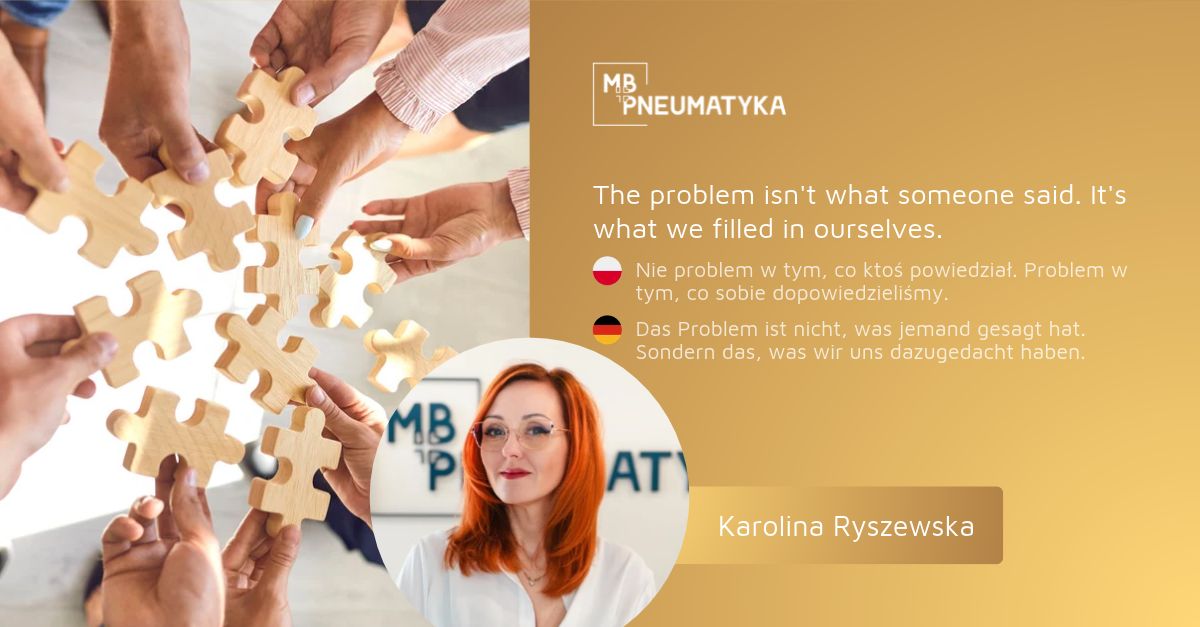
Do you really know the whole story?
At work, it's easy to forget that each of us sees a different slice of reality.
A manager may have several conversations, analyses and attempts to solve a problem behind them. An employee – or someone watching from the sidelines – sees only the final decision. Or a single reaction.
And builds a whole opinion on that.
It works the other way, too. You can be right and still put it across in a way that makes you look like the one who's wrong.
That's why I believe that the more influence you have over other people, the more responsibility you carry for how you say things. Not just for what you say.
And this isn't only about managers or the board. It's about every one of us.
Before you judge, ask
In conversations with employees, I often suggest a simple rule:
FACT → MY INTERPRETATION → QUESTION
Instead of:
"You did that because you wanted to punish me."
Try:
"I took this decision as a consequence of what happened earlier. Do I understand the reasons behind it correctly?"
A small difference that changes the whole conversation. You're not attributing intentions you can't know. You're talking about what you yourself see and feel:
"The way I took it…"
"I have the impression that…"
"From my perspective…"
This isn't a way to avoid difficult conversations. Quite the opposite – it's a way to have them without accusations that help no one.
Not every misunderstanding starts in a conversation
There's one more thing that's easy to forget.
Sometimes the issue isn't how we talk to each other. It's that we never clearly agreed who is responsible for what.
Who passes on the information? Who makes the decision? Who does the work? Who do you go to with a problem?
In a growing company, roles and responsibilities change naturally. That's a good thing. But it also means they need regular tidying up – otherwise they quietly drift apart.
That's why in November, the entire administration team at MB Pneumatyka is getting together. We want to take a fresh look, together, at how we divide tasks and responsibilities and how we work with each other.
The goal is simple: fewer misunderstandings, a smoother flow of information, and no more tasks without an owner – or tasks everyone assumes someone else is handling.
Because good communication isn't just about knowing how to talk. It's also about sharing an understanding of what we expect from each other.
Who's responsible?
Both sides.
I don't think the person passing on information is solely to blame for every misunderstanding. But I don't think the whole burden falls on the listener either.
The sender should make sure the message is clear and remember that others may not know the full context.
The receiver should hold back from snap judgements and be ready to ask questions.
And people who lead teams should remember one thing in particular: their words don't reach just one person. They shape the atmosphere and the level of trust across the whole organisation.
One question
Communication isn't always about who's right. Sometimes what matters more is whether both sides are even talking about the same thing.
The longer I work with people, the more convinced I am that many conflicts could be avoided if we asked one simple question more often:
"Do I understand correctly that…?"